Wednesday, August 10, 2011

Christ Church College Library, Oxford University

After our trip to the main Oxford University library, the Bodleian, we visited Christ Church College Library and Archives.  We talked to Christina, one of the special collections librarians. Christ Church College was founded in 1525, and the library was founded soon thereafter in 1562 in the upper rooms of a former Augustinian priory. The library moved into its present location in 1772. The history of the library in more detail can be found here
An outside view of the library: http://www.chch.ox.ac.uk/sites/default/files/images/development/librarywide.jpg

Christ Church library is split up into two main collections—special collections and then modern collections. The special collections are made up of many rare and early printed books and manuscripts, which are arranged by the donor’s name—the library hasn’t changed the order of the collection since it opened in 1772. The provenance of the special collections are interesting, as many of the donors made notations in their books, which adds to their uniqueness; for example, in the Wake collection, who was the Archbishop of Canterbury, many of his books have notations. Another collection that they have is the Orrery collection, which is made up of early medical and science books. Many of their special collections also came with artifacts—one of the interesting artifacts that they had in their reading room was the oldest felt hat in the world. They also have a fairly extensive music collection, which contains many early printed scores, including a manuscript of Handel’s Water Music. There are also about 700 manuscript collections, in Roman, Byzantine, Arabic, and other languages, as well as royal manuscripts.   They’ve been attempting to put the special collections into the online catalog and are about two thirds of the way through the collection.
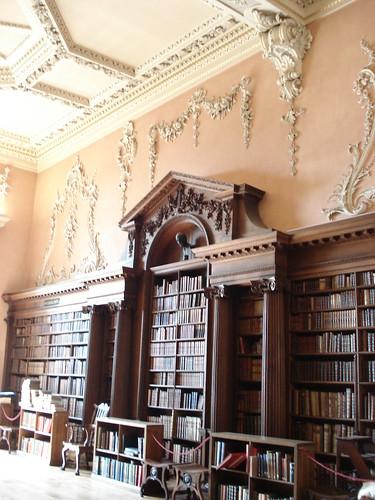
The reading room: http://farm2.static.flickr.com/1383/1393725747_9e89636451.jpg
Christ Church library also serves as a research library for the students within the college, so in their modern collections they collect for all of the subjects within the college—since each college is autonomous, they buy much of the same material as other colleges, and space has become an issue as all of the colleges each have to have certain texts to support student learning.  Their modern collection is in their online catalog and also goes into the Oxford Union Catalog. Christ Church College students, faculty, and fellows are able to access the library; other academic researchers should make an appointment and let the college know how using the library will benefit their research. They have two or three researchers usually each day in their special collections.

The librarian that gave us the tour, Christina, was very gracious and helpful—I learned a lot from her about the library and Christ Church’s history.  The library itself was beautiful and their collections were very impressive. All of the Oxford University area was magnificent, with grand architecture. Oxford was just a charming little town.  

One other interesting thing about the library was that they had a Charles Dodgson (Lewis Carroll) exhibit up when we were there, displaying his books about logic (he was a mathematician), some photos, poems, and facsimiles of the Alice books. Charles Dodgson is one of Christ Church’s most famous alumni and he still has a large presence, with an Alice shop across the street. We got to see the courtyard where Alice (the dean’s daughter) would play, and Dodgson would interact with her. We also learned that Charles Dodgson actually worked at the Christ Church library for a time and we got to see his probable office. We also went and saw the staircase that was used in the Harry Potter films that Harry and his friends go up when they first arrive at Hogwarts, and the room that the Great Hall was modeled after. All in all, our trip to Oxford was a fun day!

Bodleian Library, Oxford University

On July 15th, we took a day trip to Oxford to visit two of the libraries on campus. We first went to the Bodleian Library, which is the most famous of the Oxford University libraries and the largest. It is a research library for all of the colleges at Oxford and it has world-renowned collections. It is also a legal deposit library for the United Kingdom and thus they have around 11 million volumes in their collection. However, we weren’t able to actually see any of the materials that the Bodleian has on our tour—we were just able to take the tour for the general public—this is probably so visitors don’t disturb those who are actually trying to work.

http://www.librarystudentjournal.org/index.php/lsj/article/viewFile/62/157/521
We had a very nice and informed tour guide and learned a lot about how Oxford operates and the history of the university.  Oxford University was founded in the twelfth century after English scholars were expelled from the University of Paris. Oxford University is made up of thirty-eight colleges, all of which are autonomous and financially self-sufficient under the umbrella of the university; each college offers numerous subjects of study and each subject normally has 10-12 students studying at one time. Each student has to meet with a fellow within their subject once per week; they usually have to write a paper on a certain topic for the student and fellow to discuss that week; there are also lectures that students can attend to aid in their learning. The oldest colleges date back to the 13th century, and these include Balliol and Merton

The first library at Oxford opened in about 1320, it was added to the University Church of Saint Mary the Virgin on the upper floor--this was because the risk of rising water from the river was too great. This library was used for about 100 years. In the 1430s, Duke Humfrey of Gloucester donated a large collection of books, and the library did not have the storage capacity for the collection, so they built a room above the Divinity School which is still known as Duke Humfrey's Library. The support for libraries was in decline in the 15th and 16th centuries, and much of the furniture and collections were sold or ruined; only three books from the original collection still remain in the library.

In the late 16th century, Thomas Bodley, a former fellow at Merton College, offered to reestablish the university library. Bodley paid to refurbish the Duke Humfrey's library and he donated some of his sizable collection to the library. Bodley also made an agreement with the Stationer's Company to have a copy of every book registered with them donated to the Bodleian, and due to this and other large donations, the library has expanded into multiple buildings with many off-site storage facilities.


The Bodleian library is primarily a reference library; no books can be lent from the library and there are closed stacks with several reading rooms. Each of the thirty-eight colleges has its own library and each department within the college also has a library from which books are lent. The books are arranged using a shelf-numbering system, with the bay and shelf number marked. All Oxford University students and faculty are able to use the Bodleian as are academic researchers who are either postgraduate students or affiliated with an institution. Undergraduate students and non-university researchers must prove that it is critical to their research to use the Bodleian. Undergraduates from other institutions can only use the library during university breaks. All non-Oxford researchers must pay a fee to use the library; one can choose to pay for one week to four years admission.

I thought that the tour was very interesting, and that we learned a lot about Oxford history and education within the university system in Britain. We also learned a lot about the architecture of the buildings and the history of the Bodleian; I wish we could have learned more about the current and special collections that the library owns, and their current preservation practices, so that we could have compared the Bodleian with the British Library, London Library, and other like institutions with very old books (which seems to be every library in the UK!) I wish we could have seen more, but its probably not often that they allow non-affiliated groups to tour the special collections and library.

Monday, August 8, 2011

Royal Geographical Society Library

After the National Art Library, we went down the road to visit the Royal Geographical Society Library. The Foyle Reading Room, where the library and archives are housed, was recently remodeled in 2004 and made more accessible so that more people would be able to research. It was also built in order to bring together all of the elements of the library that were previously scattered around on various floors of the Royal Geographical Society building. Previously, there were rooms for the library, archives reading room, photo reading rooms, and a map room. The librarian, Eugene Rae, also told us that there was a feeling that the research rooms were previously an old gentleman’s club, but now with the new handicap accessible building and with much improved areas for research that the library is trying to attract more researchers and promote the services that the library offered.  If one wants to use the library, there is a £10 charge per day for using the facility for non-members; however, if one is using the materials in the course of completing one’s education or for scholarly research, it is free to use.  Only members of the Society are able to check out books and periodicals from the library.
The Royal Geographical Society: http://upload.wikimedia.org/wikipedia/commons/thumb/1/10/The_Royal_Geographical_Society%2C_Kensington.jpg/800px-The_Royal_Geographical_Society%2C_Kensington.jpg

The collections at the Royal Geographical Society library are very large and diverse. The collection is made up of about two million items—1 million maps,  500,000 photographs, several thousand boxes of archival materials, and 1500 artifacts. We were shown a display that was themed ‘hot and cold’ and showed materials from Arctic, South American, and African exploration by British explorers. One thing that I thought was interesting about the artifacts and other materials that the Society had was that the Society had a store of tools and other instruments that were needed for the explorers’ journeys and they would have a sort of instrument library, and once explorers like Edmund Hillary got back from climbing Mount Everest, or Percy Fawcett got back from South America, their items would be given back to the Society, but then those items had new found importance kept as artifacts of important expeditions. Mr. Rae told us the stories behind each of the items set out, including a stove from Admiral Peary’s expedition to the North Pole, The South Polar Times, a newspaper from the Shackleton expedition with poems, stories, and drawings, maps from when British explorers were trying to figure out the source of the Nile, David Livingston’s hat, a map of Arabia drawn by T.E. Lawrence, and Charles Darwin’s sextant from his voyage on the Beagle.

The story behind the items we were shown were spectacular and this was probably my favorite library because of this; the collections that the library has were interesting and focused, unlike many of the other libraries we’ve visited. For example, many of the libraries had old, rare books that had nothing to do with their purpose just because they were rare and they were donated by a benefactor. The Geographical Society Library seemed to be very focused on geography and exploration, and it was nice to have a collection tell a story. I would love to go back someday and just look at some of their treasures.

The Foyle Reading Room: http://www.21stcenturychallenges.org/images/uploads/events/Foyle-Reading-Room-RGS.jpg
We discussed the accessions policy for manuscripts and artifacts with Mr. Rae, who told us that they like to acquire items that have interesting stories attached to them, but that they rely mostly on donations for these types of items as they don’t have the funding to purchase them.  We also discussed whether or not the library has engaged in digitization, and they have digitized over 12,000 photographs, which can be seen on their Web site, and prints of the images can also be ordered there. The library also has an extensive online catalog; items are still being added every day from the four separate card catalogs from previous years. They’ve also been engaging in an oral history project in which they discuss the idea of exploration with people of different ethnicities and backgrounds and they get different perspectives on the ideas of “discovery” and “exploration” of lands that were inhabited; in this way they get the postcolonial perspective. I thought that the programs, collections, and staff of the library were very welcoming, interesting, and impressive, and I would love to work in a library or archive similar to this after graduating.

Sunday, August 7, 2011

National Art Library at the Victoria and Albert Museum

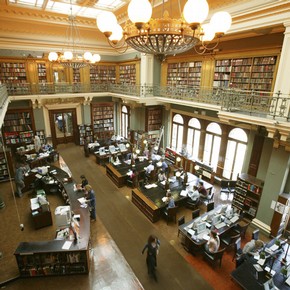
On July 14th, we visited the National Art Library, which is housed in the Victoria and Albert Museum (V & A museum).  We were given a tour of the library and then were shown many of the library’s treasures.  The National Art Library predates the V&A, beginning first in Marlboro House in 1837, then moving to Somerset House, and then finally in 1884 moving into the V&A museum.  The library collects materials and documents about art and artists from all over the world, as well as materials on the history of the book, book arts, and theatre.

The Reading Room: http://media.vam.ac.uk/vamembed/media/versions/uploads/new_images/2006ab9999_nal_reading_room_290x290.jpg
The library is very accessible, any member of the public can use the materials for free; users must register for a reader’s card.  It has closed stacks, so readers must request materials to be brought to them by staff members, which they retrieve every 1 1/2 hours. The library contains 8000 volumes, 2000 periodicals, and contains textiles, furniture, and other artifacts as well.  They have many trade catalogues and reports from auction houses and galleries, which researchers often use to trace the ownership history of items. Their users are mostly postgraduate researchers and academics doing research for dissertations and theses, as well as employees of auction houses and galleries doing research for sales, and the curators of the V&A use the library to do research for their exhibitions. The library also collects files on artists, which include newspaper clippings, invitations to artists’ exhibitions, and other materials on artists’ lives.

While we were there, we were also fortunate to see some of the special collections that the National Art Library has—we were able to see and look through a rare facsimile of the Leonardo DaVinci codices, an illuminated manuscript from the 15th century, an artists’ book made completely of rabbit fur, the manuscript of David Copperfield by Charles Dickens, and a book of John James Audubon’s paintings. The materials were very cool to be able to see close up and to flip through—it was nice that the library allowed us to do that, as these materials are very rare and priceless. We asked if the library was thinking of digitizing many of these rare materials, as the British Library and other institutions with similarly old and valuable material have done in order to still allow people access but be better able to preserve materials.  The librarian who showed these materials to us said that there was no funding for digitization for now, but that they would like to digitize them in the future if they do get funding.

I thought that the library was very accessible—you only needed a photo ID and proof of address and anyone from around the world can get a reader’s card. Most of their materials are in their online catalogue and can be readily retrieved. Their collections were very eclectic but interesting—they have books on literature, history, science, theatre, art, and special collections that span those categories as well. If I were a graduate student in any of the arts, this would be one of the first places to look for research. The librarians were very welcoming and trusting, allowing us to see many of their rare collections.  I would love to explore their catalogue and see what other sorts of unexpected treasures the National Art Library might have.

Sunday, July 24, 2011

Stratford upon Avon

On Wednesday, July 13th, our class spent a day just wandering around Stratford upon Avon, the birthplace of Shakespeare and home to the Royal Shakespeare Company. To start off the day, a couple of  friends and I visited the Stratford upon Avon public library. We perused their stacks and looked at everything the library had to offer, which was pretty good considering the size of the town. As you walked into the library, there was a large room with public computers for Internet usage, some books to browse, and four RFID self-service check out stations. There were separate rooms for films, fiction, childrens materials, and non-fiction. There was also a room for local history and family history research. There were very few service desks within the library--I only saw two, one on each of the floors of the library. We didn't talk to any of the librarians when we were there as they seemed to be a bit busy; the library is next to the Shakespeare Birthplace and Trust, so it was very busy on a nice summer afternoon.


We had some time to kill between our visit to the library and the play we were seeing that evening, so we went and rode around on a hop on, hop off bus, which took us around to the countryside surrounding Stratford, including Anne Hathaway's Cottage and Mary Arden's Farm where Shakespeare would have visited his grandparents in the 16th century. The tour was informative, not only about Shakespeare's life, but about what was happening in the time period. We then perused, shopped, and ate at a local pub before going to see a Royal Shakespeare Company production of Cardenio, which is a lost, reimagined Shakespeare comedy about long-lost lovers. The highlight of the day was definitely the play, which was extremely well done; the actors were wonderful and the story was also quite fun. There were some elements that poked fun at Shakespeare's tragedies, which are quite comedic at times; there were some dark parts to the play and I expected people to start dying, but everything happily remained comedic. On a side note: Russ Feingold, the former senator from Wisconsin, was in the first row of the theatre, and this distracted me for a good ten minutes, trying to tell if it was actually him or not. All in all, it was a long but good day in Stratford upon Avon.

London Library

Today, we were able to visit one of the most exclusive libraries in the world. The London Library is a subscription lending library, meaning that an annual membership fee must be paid in order to check out books--which right now is somewhere around £400 per year. Apparently there are a lot of celebrities who visit the London Library, including a lot of writers--the current president is playwright Tom Stoppard. The day we visited we had just missed Hugh Grant that morning, who had popped in to use the loo and to do some research about a new film role. I like to think that Stephen Fry is probably a member, though the people who worked there weren't very revealing about those who subscribed. This discretion is probably what they pay for, but we were a bit disappointed that we didn't see anyone famous. Oh, well.


http://www.londonlibrary.co.uk/images/aboutus/exterior_lights_on.jpg
The library has a very long history--it was founded in 1841 by Thomas Carlyle, who wanted to have a library where one could actually take books home. The British Library at this time only allowed certain people to use the reading room, and books could not be taken out. The London Library has a long history of being a lending library, which predates the Public Library Acts, and which is funded by subscriptions and donations. You may still borrow some of the library's oldest books, some dating from the 16th century, and take them home to read.

The library's collections are impressive, containing over 1 million books and over 15 miles of shelving. The stacks are open, so patrons are able and encouraged to browse the shelves--97% of the books are available for loan--there are only a few that are too rare and in too poor condition to be allowed to be taken home. They have thirty thousand rare books dating from the 16th century, 2500 periodical titles, and 750 current periodicals, not including electronic resources that the library subscribes to. The library acquires around 8000 new books each year, and doesn't throw books away--thus they've had a problem with space and have had to add on to the building in several different renovations. Last summer, they completed a new wing, the T.S. Eliot wing that should give them enough space for the next 20 years.

The library is arranged by subject area, these include: arts and humanities, history, literature, biography, art, topography, science and miscellaneous, and religion. These subject areas are then further split up by subjects within these areas. For example, literature would be arranged by the language in which it is written--the library contains materials in more than 50 languages. The science and miscellaneous section might have a section on dogs, or domesticated animals, etc. They have an online catalog which contains most of the items that the library owns, but still retain paper indexes for those materials that have not yet made it into the online catalog.

We also heard from Sheila, who is a part of the preservation department at the London library; she talked to us about the way in which librarians have to monitor the well-being of books and make informed decisions about whether preservation or access is more important for rare materials--we also discussed this issue in many of the other libraries we've visited. While it is important to make sure that people are able to use materials of this sort, it is also important to restrict that access in some cases in order to make materials available to future generations. One solution to this problem is digitization, something that the London Library has yet to really undertake. However, they do keep in mind that the preservation standards of today might not be considered the best in the future, so they only preserve books in ways that are reversible if need be--for example, they use an organic wheat paste that is water soluble.

Although I thought the collections of the London Library and their clientele are both very impressive, there is something in me that doesn't understand the exclusivity of the London Library. To make the library more accessible to people who may not be able to afford the subscription fee, the library has a London Library Trust, which provides a sort of scholarship for membership to the London Library. Membership in the London Library seems to be a sort of status symbol; one could say they were in the same organization as George Eliot, Charles Dickens, Winston Churchill, Charles Darwin, Henry James, T.S. Eliot, and more. The London Library has been able to achieve a very rare and exciting collection of books that have survived because it is exclusive and well-funded.  I really enjoyed my visit to the London Library, the librarians who showed us around were very welcoming and very nice, and they provided us with a lot of good information about one of the oldest lending libraries in the world.

Stephen Lawrence Gallery, University of Greenwich

On Monday, July 12, we visited the Stephen Lawrence Gallery in Greenwich. We took a boat on the Thames to get to Greenwich, as it isn't easily accessible by tube or bus. We were a bit late due to a misunderstanding--apparently the Stephen Lawrence Gallery is not in the Stephen Lawrence building at the University of Greenwich. We were greeted with a brightly colored exhibition of paintings, drawings, and sculpture--most of the art showed abstract influences, but I feel that I'll fail in actually doing the pieces justice here, so if anyone reads this and would like to see some of them, I might have a brochure that you can look at.

The gallery was established in 2000 as a place to display art for the University of Greenwich. The way that the gallery was named is a rather sad story. In 1993, Stephen Lawrence, a black teenager from Eltham in southeast London, was murdered at a bus stop. It soon became evident that the teenagers who perpetrated the crime would  not be prosecuted because they were the sons of wealthy families; this led to press outcry about the injustice surrounding this crime. Because of this, the government carried out an investigation of the crime and it found that there was "institutionalized racism" pervading all sectors of English society, including the police, and that all organizations should analyze their structures. At this time, Doreen Lawrence, Stephen's mother was working at the University of Greenwich, and it was proposed that a gallery be founded in order to create a positive area where diversity could be promoted through art created by young people of varying backgrounds. The gallery attempts to reach as wide of an audience as possible, and promotes all types of visual representation, including painting, sculpture, graphic design, and architecture.

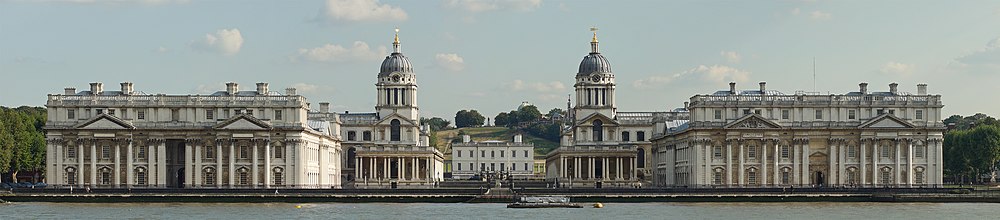
Old Royal Naval College, http://en.wikipedia.org/wiki/Old_Royal_Naval_College
The exhibition that was being shown while we were there was called "Uncaught Hares: Painting and Sculpture at Greenwich Studios, 1974-1994." It was all of local artists, many of whom had been a part of the studio movement of the 1970s, during which a large number of artists banded together to create studios in abandoned industrial buildings in the dockyards of Greenwich. After prosperity came back to industry, and the Greenwich Studios were closed in 1994,  an organization called Art in Perpetuity Trust was created and now helps to provide artists with studio space in the London area by buying up old buildings and renting them out to young artists. Previous exhibitions include archival materials relating to artists movements in Greenwich, as well as other exhibitions of art which can be viewed here.

The gallery is open to the public and is free for them to browse. The artworks contained within the gallery are available for sale. The man who manages the gallery brings in other curators to actually hang and arrange the artworks.

Today, we also toured the Old Royal Naval College, in which the Stephen Lawrence Gallery now is housed. The buildings were first royal palaces, built by Henry VII on the Thames because they allowed invasion routes to be monitored easily. Tudor queens Mary I and Elizabeth I were both born here. The buildings that now stand in the area were designed by Christopher Wren in the late 1600s and early 1700s. They then were used as a home for naval pensioners, much like veteran's homes that we have in the States, from about 1705 until 1869. The navy then used the buildings as a place to train naval officers until they gave up the lease to the property in 1998; it now houses the University of Greenwich and Trinity College of Music. 

Great Painted Hall, from Wikipedia
The most interesting place that we visited, I thought, was the Great Painted Hall, which was painted by James Thornhill in the 18th century. The walls actually look like they are carved rather than painted. The hall was to be a dining hall for the naval pensioners living in the college at that time; however, they felt uncomfortable dining in such a lavish area, and continued to dine in the more modest basement. The hall was used recently for filming and can be seen in the opening scene of the newest Pirates of the Caribbean film. They had Johnny Depp's costume on display while we were there. We also got to see an old bowling alley in the basement of one of the buildings.

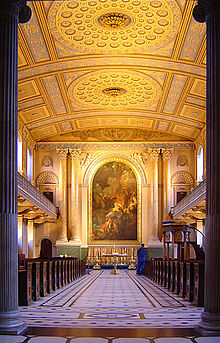
Chapel, From Wikipedia


We also got to see the chapel of the Old Royal Naval College, which was quite beautiful. There is a painting by American painter Benjamin West above the altar, who was the second president of the British Royal Academy and was considered the "American Raphael". The ceiling of the chapel was one of the most gorgeous that I've seen anywhere in England, with intricate detailing.